Cabo Verde in the First South Atlantic Air Crossing 2026-06-16
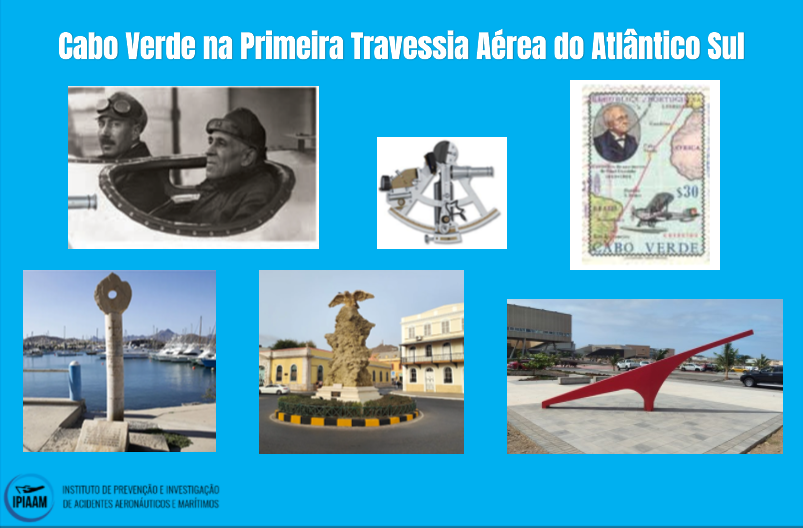
Sacadura Cabral and Gago Coutinho, officers of the Portuguese Navy, entered world aviation history by carrying out, in 1922, the First South Atlantic Air Crossing. This extraordinary journey linked Lisbon to Rio de Janeiro and was part of the centenary celebrations of Brazil´s independence.
The passage of the two aviators through Cabo Verde constituted a decisive stage of this historic crossing. The expedition began on March 30, 1922, when they departed Lisbon aboard the Fairey F.III-D seaplane, named Lusitânia. The journey proved particularly demanding, marked by mechanical failures and the loss of aircraft along the way. Despite the difficulties, and after using three different seaplanes – Lusitânia, Pátria, and Santa Cruz – the aviators successfully completed the 8,383-kilometer crossing, landing in Guanabara Bay, Rio de Janeiro, on June 17, 1922.
The first stop of the journey took place in Las Palmas, in the Canary Islands. A few days later, on April 5, 1922, Gago Coutinho and Sacadura Cabral arrived on the island of São Vicente aboard the Lusitânia. This was the first aircraft ever to land in Cabo Verde, and the aviators were received with great enthusiasm by the population of Mindelo.
Their stay in Cabo Verde lasted several days due to the need to study weather conditions and address issues related to fuel consumption before the most difficult stage of the journey.
Later, they traveled to the island of Santiago. From Praia, on April 18, they departed for the so-called “Great Leap,” bound for the Saint Peter and Saint Paul Archipelago, located more than 1,600 kilometers away.
This stage assumed particular importance as it demonstrated the effectiveness of the innovative navigation instruments developed by Gago Coutinho, particularly the sextant, which enabled the aviators to locate the small, isolated rocks in the middle of the Atlantic with remarkable precision.
Thanks to this historic event, Cabo Verde occupies a prominent place in the history of world aviation.
In Mindelo, a monument commemorates the air crossing and the passage of Gago Coutinho and Sacadura Cabral through the archipelago. Years later, another monument was erected in honour of the aviators, crowned with a statue of an eagle with outstretched wings, popularly known as the “Pósse”.
In Praia, a monument was also erected in honour of the two aviators, in Achada Grande Frente, in the remaining area of the former Francisco Mendes Aerodrome.
Cabo Verde was, therefore, much more than much more than a simple technical stopover: it was the starting point of the most risky and emblematic stage of the First Air Crossing of the South Atlantic, contributing decisively to the success of one of the greatest feats of aviation of the 20th century.
#CaboVerde #AviationHistory #AirCrossing #SouthAtlantic