Suez and Panama: The Canals That Connect the World 2026-08-12
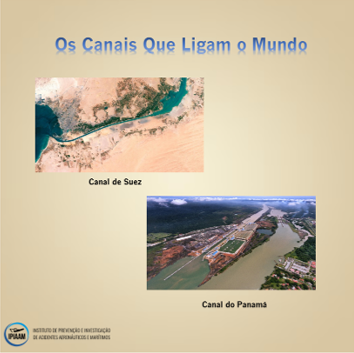
The Suez Canal and the Panama Canal are two of the most important artificial waterways in the world, playing a central role in international trade by significantly reducing the distances of major maritime routes.
The Suez Canal, located in Egypt, connects the Mediterranean Sea to the Red Sea and was inaugurated on 17 November 1869, after around ten years of construction. It is a sea-level canal, approximately 193 km long, which has no locks, allowing the continuous passage of ships.
The Panama Canal, in turn, connects the Atlantic Ocean to the Pacific Ocean through the Isthmus of Panama. Its construction took place between 1904 and 1914, and it was inaugurated on 15 August 1914. The “SS Ancon”, an American cargo and passenger ship, was the first vessel to officially cross the Panama Canal. Until then, navigation between the Atlantic and Pacific Oceans required sailing around South America via Cape Horn, making voyages significantly longer.
Measuring about 82 km in lenght, it includes a system of locks – Gatun on the Atlantic side, and Pedro Miguel and Miraflores on the Pacific side – which raise ships to Gatun Lake and then lower them back to sea level on the opposite ocean.
In terms of capacity, the Suez Canal can accommodate large vessels, including tankers and container ships of the “Suezmax” class, without the restrictions imposed by locks. The Panama Cana has five sets lock: three from the original system and two added during the 2016 expansion. The new locks – Agua Clara on the Atlantic side and Cocolí on the Pacific Side – allow the passage of larger vessels known as “Neopanamax”. The Panama Canal, however, imposes more specific limitations than the Suez Canal, distinguishing between “Panamax” vessels (compatible with the original system) and “Neopanamax” vessels (adapted to the expanded locks).
Both canals are used by different types of vessels, including container ships, tankers, bulk carriers, LNG carriers (liquefied natural gas transport ships), general cargo ships, and cruise ships, reflecting their strategic importance for global maritime transport.
According to the authorities of the Suez Canal and the Panama Canal, in terms of traffic, the Suez Canal records, in normal operating years, between 18,000 and 20,000 transits annually, moving more than one billion tonnes of goods. The Panama Canal records approximately 13,000 to 14,000 transits per year, transporting hundreds of millions of tonnes of cargo.
Thus, both canals constitute fundamental axes of global trade, helping to reduce maritime distances, lower logistics costs, and exert a direct influence on global geopolitics.
#PanamaCanal #SuezCanal #InternationalTrade #MaritimeTransport #Geopolitics